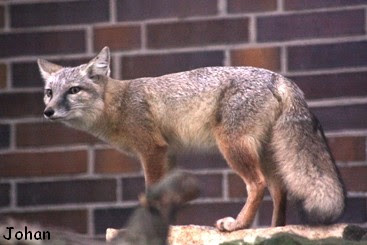
The Tibetan fox (Vulpes ferrilata), also known as the Tibetan sand fox, is a species of true fox endemic to the high Tibetan Plateau and Ladakh plateau (Nepal, China, northern India and Bhutan) up to elevations of about 5,300 m (17,400 ft), making them the canid species with the higher elevation range, and one of the mammals overall as well.
Is a small-sized canid, with a conspicuously
narrow and long muzzle and a rather square head. Pelage is soft and thick, pale gray or sandy, with a tan to rufous band along the dorsum. Muzzle, crown and neck are reddish.
Underparts are white. Vertical gray to black bands between the forelegs and chest.
Ears are
small, white inside, tan outside. They have a distinctive elongated muzzle. Forelegs are russet, tail is
bushy, mostly gray, with a dark streak near the base in the supracaudal gland, and a white tip. Among the true foxes, its skull is the most specialised in the direction of carnivory; it is longer in length, and in mandible and cheek tooth length, than those of other foxes. Its cranial region is shorter and the arches narrower. Its jaws are also much narrower, and the forehead concave. Its canine teeth are also much longer than those of hill foxes.
About the species
Reproduction and behavior
Gestation: 50-55 days.
Young per birth: 2-5.
Weaning: the weaning and sexual maturity are unknown.
Life span: between 8 and 10 years.
Breeding season: From December to March.
Young are born between February and May. The tibetan foxes are monogamous. Dens are usually
found in grasslands with moderate slopes. Young do not emerge
from the dens until they are several weeks old. Males participate in
pup rearing.
Social behavior: they are mainly solitary, although they can be seen
in family groups of a mated pair with young. Mated pairs remain together and may also hunt together.
Diet and interaction with the environment
They are foraging specialists, preying predominantly on pikas, but also rodents, other small mammals, lizards, insects, berries and carrion. Main predators: feral dogs, gray wolf, raptors.
The tibetan foxes are crepuscular, most active at dawn and dusk, although can be seen at any time of the day. They spend considerable time resting in small burrows, hollows and rock crevices; there may be 1 to 4 entrances to a den. They may form commensal relationships with brown bears during hunts for pikas, in which they capture pikas excavated but not captured by bears. Also reported to scavenge on wolf kills.
They are not territorial, and many pairs have been found living in close quarters and sharing hunting grounds. They often deposit their droppings in conspicuous places. Vocalizations consist of short yips to communicate over short distances; no long-distance communication is known.
Habitat:
They are native to China, northern India, Nepal and Bhutan. Found in the steppes
and semi-deserts of the Tibetan Plateau from the Ladakh area of
India, east across China including parts of Xinjiang, Gansu, Qinghai and
Sichuan Provinces and all of Tibet, and into Yunnan, in the Mustang
area north of the Himalaya. There are no confirmed recent records for
Bhutan, meanwhile there is a confirmed record from Sikkim.
Their habitat consists in upland plains and hills, sparse grasslands devoid of trees
and shrubs, up to 5,200m, most typically above 3,500m. Rarely
encountered where pikas are absent. It primarily inhabits semi-arid to arid grasslands, well away from humans or from heavy vegetation cover. It lives in upland plains and hills from 3,500 to 5,200 m (11,500 to 17,100 ft) elevation, and has occasionally been sighted at elevations of around 2,500 m.
Conservation status: Least Concern. Regionally are endangered in China.
Estimated population of 10,000. There are no major threats,
although habitat loss and poisoning of pikas across much of the
Tibetan Plateau may damage Tibetan Fox populations. They are
hunted for pelts, which are manufactured into hats in Tibet. They are legally
protected in several large Chinese reserves as Arjin Shan, Xianza,
Chang Tang, Kekexili, and Sanjiangyuan.
Physiognomic information:
Body length: 51-72cm (♂), 49-66 cm (♀).
Tail length: 21-47 cm
Height: 27-35 cm
Weight: from 4.4 kg to 5.7 kg (♂) and 3.6 kg to 4.1 kg (♀).
Taxonomy:
Monotypic. Includes ekloni. Similar species: Corsac Fox (Vulpes corsac), which is closely related to, and sympatric in northern parts of its
range. It has a black-tipped tail, with russet-gray pelage, and a white
chin. Tibetan red fox (Vulpes vulpes montana) is similar in size, but longer legged, slenderer, has
longer, sharply pointed ears, lacks the distinct line along the midflank
that separates gray from russet color, and the gray to black bands
running vertically between the russet forelegs and white chest.
The Bengal fox (Vulpes bengalensis), also known as the Indian fox, is a fox endemic to the Indian subcontinent from the Himalayan foothills and Terai of Nepal through southern India, and from southern and eastern Pakistan to eastern India and southeastern Bangladesh.
A small-sized Fox. Coat is short and smooth, variable in color, from silver gray to grayish rufous, minutely speckled with white, pale rufous yellowish or creamy white ventrally, varying with the season and locality. Chin and throat are white. Long, pointed ears, dark brown on the back, with black margin, white inside. Rhinarium is naked and lips are black. Elongated muzzle. Black spot on each side of the muzzle in front of the eye. Limbs are brownish to bright rufous. Tail is long and bushy, with a dark patch over the caudal gland, and a sharply defined black tip. Females have 3 pairs of mammae.
About the species
Reproduction and behavior
Gestation: 53 days.
Young per birth: 3-6.
Weaning: 30 days.
Sexual maturity: 1-2 months.
Life span: 6-8 years.
Breeding season: Between November and January.
Births occur from February to April. They use
more than 1 breeding den during the reproductive period, possibly to
avoid predators. Dens are situated in the open plains, and typically
have various entrances. In alluvial plains, dens take advantage of
any small rise in the ground, to prevent being flooded. In human dominated landscapes, they may use human-made structures
(tailings, irrigation bunds, pipes). During pup-rearing season, most
of the time is spent in resting, followed by searching for food. One
parent always watches the activity of pups outside the den.
The breeding pairs may last an entire lifetime.
Diet and interaction with the environment
The Bengal foxes are omnivorous, they eat insects, small mammals (rodents), reptiles, birds and fruit. Their diet consists mainly of orthopterans, termites, ants, beetles, spiders, soft-furred rat, little Indian field mouse, Indian gerbil, Indian mynah, grey partridge and ashy-crowned finch lark. Less common prey items include ground lizards, oriental rat snake, Madras hedgehog and Indian hare. They feed on fruits of ber, neem, mango, jambu and banyan. The Bengal fox is also considered to be a predator of eggs and possibly bustard chicks. Scats of young pups indicated that they primarily feed rodents.
Their main predators are the wolves and feral dogs. Crepuscular and nocturnal, may also hunt at mid-day in absence of large predators and abundance of food. They seem to hunt alone. Not strictly territorial, but exhibit this behavior sometimes. It is a den-dependent species, and breeding pairs use dens primarily for reproduction and pup-rearing, but also for resting during the dry season. Dens are large and complex with multiple chambers and escape routes. Wide range of vocalizations: a chattering cry is the most common call, but also growl, whine, whimper and bark. t does not appear to practice site-specific defecation.
Bengal foxes are predominantly crepuscular and nocturnal; while individuals may sometimes become active during cool periods of daytime, they typically spend warmer daylight hours under vegetation or in subterranean dens. They use three distinct types of den: basic, compact dens with two openings used for short rest periods, complex dens with multiple openings, and dens under rocks or rock crevices. The basic social unit of the Bengal Fox is the breeding pair, formed by a pair of bonds that can last for many years. Larger aggregations may occur while grown pups linger longer than average in the natal community.
Other findings indicate that Bengal foxes can sometimes be more social. Female Bengal foxes were reported to share dens during lactation and four adult foxes were seen emerging from the same den. Bengal foxes are not especially suspicious of humans and can be found near human habitation. They are easy to tame.
Habitat:
They are native to Bangladesh, India, Nepal and Pakistan. Endemic to the Indian subcontinent, ranging from the foothills of the Himalayas in Nepal to the southern tip of the Indian peninsula. In the northern part of the Indian subcontinent, it extends from Sindh Province of Pakistan to northern Bengal in India.
Habitat: semi-arid, flat to undulating terrain, scrub and grassland. It avoids dense forests, steep terrain, tall grasslands and true deserts. They may compete with the desert race of the Red Fox. They do not penetrate into the mountainous tracts of Balochistan or the Himalayas. Tolerant of human presence, they can be found
in agricultural fields and the vicinity of rural habitation.
Conservation status: Least Concern. Regional status: Vulnerable in Bangladesh and Nepal, near threatened in Pakistan. Protected in India and Bangladesh, but it has not been the focus of targeted conservation efforts. Widespread in the Indian subcontinent, but occurring at low densities throughout its range, with population on the decline due to loss of short grassland-scrub habitat to intensive agriculture, industry and development projects. There is also a limited localized trade for skin, tail, fur, and teeth and claws. There is no quantitative data available on its population size.
While the Bengal fox is common, it usually occurs at low densities across its range, and populations may experience significant fluctuations due to prey abundance and disease (canine distemper virus and rabies, which have been confirmed to cause local population declines in western India). Any human disruptions can be tolerated, but with the increase of human populations and the increased growth of grasslands for agricultural and industrial use, the habitat of the Bengal fox is continually being reduced. The combination of the above causes, combined with disease and/or natural mortality, could potentially cause localized extirpation.
Lack of habitat protection is perhaps the greatest threat to the Bengal fox. For example, in southern India, less than 2% of potential Indian fox habitat is covered under the existing protected area network of the states of Karnataka and Andhra Pradesh. Hunting for its skin and flesh, as well as conversion of its grassland habitat to agriculture, industry, and increasingly bio-fuel plantations, have affected its population density. In addition, its body parts are used in traditional medicine, and in some areas it is eaten. They are hunted by the narikuruva tribes of southern India. In Karnataka, they are captured in rituals conducted during Sankranthi.
It is the southernmost subspecies of corsac within its range. They occupy most of the southern plains of central Asia. Like the other corsac subspecies, they avoid high altitudes and prefer broad steppes. Like their Caucasus counterparts, they differ little from the common corsac fox, differing only in their generally smaller size, and the bit whiter fur in winter.
About the species
The Turkmen subspecies are the smallest corsac subspecies, with shorter, coarser winter fur of dirty-grayish color and reddish tones. There are wide zones of transition between subspecies.
For a fox, it has small teeth and a wide skull. It has a number of scent glands, some of which produce pungent odors, although not so extreme as those found in some other Vulpes species. As in other corsac foxes, are reported to bark during hunting or when threatening rivals, and to use higher pitch yelps or chirps as alarm calls or social greetings.
Reproduction and behavior
Gestation: 52-62 days.
Young per birth: around 5.
Weaning: 28 days.
Sexual maturity: 9 months.
Life span: Around 9 years.
Breeding season: January to March.
Diet and interaction with the environment
The diet of this subspecies is mainly omnivorous, although it focuses on small rodents, as well as insects and fruits. A characteristic of the turkmen foxes is that they can go without water for extensive periods
of time, usually longer than other corsac foxes.
It has no defended territory, and unlike other fox species, sometimes they forms packs. Daytime activity is most frequent at times when food is needed and when food is scarce, during the winter. It digs its own dens, usually shallow, but also the burrows of other animals, such as marmots, groundhogs or badgers. Dens can have multiple entrances, but are usually one meter deep. The burrow is shared between social packs, with dens and connecting holes. As corsac foxes, they are excellent climbers, but not good runners, and could be caught easily by a dog.
Habitat:
Native to Turkmenistan (as the name of this subspecies suggests), Uzbekistan, lowest regions of Kyrgyzstan and Tadjikistan, as well as most northern parts of Iran and Afghanistan, and southern Kazakhstan. There are a few indications of sightings in China, although rare, it is possible that its range extends to the westernmost limits of the country. They mostly inhabit grassland steppes, semi-deserts and deserts, avoiding
mountains, forested areas, dense vegetation and cultivated lands.
Conservation status: There are no estimates of population size and few details are known about the characteristics of regional populations, but it is considered widespread and common. As of 2014, the corsac fox species are listed as least concern in the IUCN Red List.
Physiognomic information:
Body length: around 40 cm
Tail length: around 20 cm
Height: usually less than 30 cm
Weight: 1.6-2.1 kg
Skull: around 10 cm
Taxonomy:
Gallery:
Because of its similarity in appearance to the common corsac fox, some of the images may be erroneous. That's why I haven't found any videos about this subspecies either, if you think you have any image or video of the Vulpes corsac turcmenicus let me know in the comments or contact me on my social networks (@etzharai).


.png)
.png)
.png)
.png)
.png)
.png)
.png)