Buscar

miércoles, 15 de marzo de 2023

Cape Fox (Vulpes chama)


THE CAPE FOX


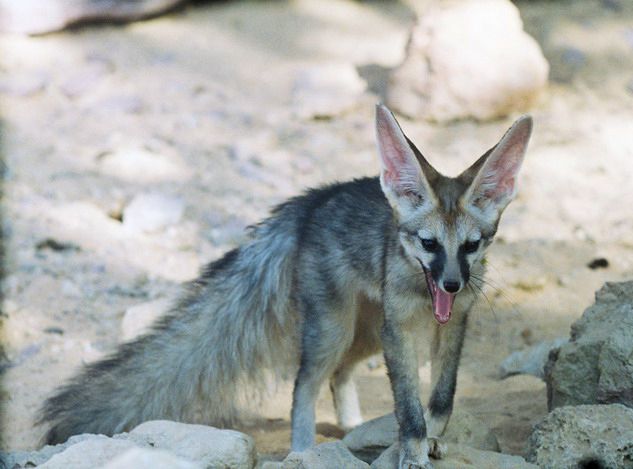
The Cape fox, also called the "asse", "cama fox" or the "silver-backed fox" is a small-sized, lightly built Canid, with slender legs. It is also called a South African version of a fennec fox due to its similarly big ears. Coat is soft, silver gray on the back and reddish brown to pale tawny brown on the flanks and underside. Molting period from October to December. Neck, legs and chest are lighter, from a pale reddish brown to almost white. Dark coloring around the mouth. Large pointed ears, reddish brown on the back, with an inner white fringe. Pointed muzzle, light in color. Hind limbs have a dark brown patch on the back of the thighs. Paws are pale fawn to reddish. Tail is long and bushy, darker than the rest of the body, with a dark patch over the caudal gland, and a black tip. Females are slightly smaller than males, with 3 pairs of mammae.

The ears are relatively large and sharp, the muzzle is small and pointed. Pelage colour is silvery-gray, tawny at the back of the ears, with white hairs appearing around the side of the pinna in the center. The colour of the neck and sides is lighter, and the underparts are pale tawny to pale buff. The head is dull red and the lower jaw is dark brown. There are white marks on the throat. The legs are more tawny than the rest of the body. The tail is dense and bushy, and can be silvery, pale fawn, buff with brown or black tips, or dull yellow. The tail tip is always black, and there's a dark spot over the caudal gland.

The Cape Fox is the only true Fox in the southern hemisphere on Africa. The Bat-Eared Fox is similar in size, but its coat is more bushy and silvery gray, with larger dark-backed ears, and black legs. 

About the species

Reproduction and behavior 

  • Gestation: 50-53 days. 
  • Young per birth: 1-6, usually 3. 
  • Weaning: 112 days. 
  • Sexual maturity: 9 months. 
  • Life span: From 6 to 10 years.  
  • Breeding season: All the year, but specially between August and October.

The adult female remains with newborn young in an excavated or adapted burrow, and is provisioned by the adult male. Pups begin to forage with the female at about 16 weeks, become independent of her at about 21 weeks, and disperse after 9 months of age. The Cape Fox is monogamous. 

Diet and interaction with the environment


Their diet consist primarily small rodents, but also insects, birds, reptiles, hares, springhares, and fruit (bluebush berries); they also eat carrion when available, and may sometimes prey on newborn lambs. Main predators: Black-Backed Jackal, caracal, leopard. Mainly nocturnal, although youngsters are known to play outside the den during the day. It can be spotted during the early mornings and early evenings. 

The Cape fox is territorial, based on high site fidelity and low overlap of home ranges between neighboring Foxes. Female-based social organization, with female-biased dispersal. Territories are maintained by frequent marking. Home ranges are 1 to 30 km2 , with differences in size based on food resources and Black-Backed Jackal density. Densities are inversely related to Black-Backed Jackal densities, due to the high predation and spatial displacement of Cape Foxes by Jackals. It can dig its own hole, but prefers to use existing dens that were dug by another species like the springhare. When attacked, it will growl and spit at its opponent; it will raise its tail whenever excited. It is normally silent, but communicates with chirps, calls, or by whining. A high-pitched howl, answered by the mate with a bark, is probably a long-range contact call, or an advertisement that an area is occupied. A bark is also used as an alarm call. Facial expressions, but not tail positions, play a prominent role in communication.

Although a normally silent fox, the Cape fox is known to communicate with soft calls, whines or chirps. However, it will utter a loud bark when alarmed. A long-range vocalization of yelps or yapping barks has been described, but Cape foxes apparently do not howl. When in an aggressive mood, the Cape fox is known to growl and spit at its attacker. They may use other forms of communication, such as facial expressions and tail posturing; to show its excitement, the fox lifts its tail, the height of the tail often indicating the measure of excitement.

Habitat:

Native to Angola, Botswana, Namibia, South Africa and Eswatini (Swaziland). Widespread in the central and western regions of South Africa, reaching to southwestern Angola. It has recently expanded its range, reaching the Atlantic and Indian Ocean coastlines. Status in Eswatini is uncertain, but they may occur in the south. Not confirmed from Lesotho. It is the only "true fox" occurring in sub-Saharan Africa, and it retains primitive characteristics of Vulpes because it diverged early in the evolutionary history of the group.

Their habitat consists in open arid country, grassland with scattered thickets, and lightly wooded areas, particularly in the dry Karoo regions, the Kalahari and the fringes of the Namib Desert. Also penetrate moderately dense vegetation in lowland fynbos in the Cape region, as well as extensive agricultural lands. Not found in forested areas.

Conservation status: Least Concern. Regional status: Least Concern (South Africa). Common across much of its range. Estimated population of 50,000-100,000. Illegal use of agricultural poisons on commercial farms poses the main threat. Treated as a vermin across most of its range, but partially protected in several South African provinces. Habitat loss doesn't appear to be a major factor influencing the conservation status of the Cape fox; in some regions, changing agricultural practices have resulted in range extensions for this species. As these foxes are presumed to prey on livestock, in particular lambs, they are commonly target by farmers. 

These control measures do not seem to have had a major impact on populations of the Cape fox, even though they have resulted in declines in some areas. They also often succumb to diseases such as rabies and canine distemper, and a large number of Cape foxes are killed on the road by vehicles. Many are hunted and persecuted as vermin. About 2,500 individuals are killed yearly; which is approximately 16% of the population. Nonetheless, populations of V. chama are currently stable across their entire geographic range. 


Physiognomic information:

  • Body length: 45-61 (♂) , 51-62 cm (♀) 
  • Tail length: 25-40 cm. 
  • Height: 30-43 cm. 
  • Weight: 2-4.2 kg (♂), 2-4 kg (♀)   
  • Skull: 10.1 cm

Taxonomy: 


Gallery:


You can watch a lot of HQ videos on NatureFootage's YouTube channel. 


Sources: 

Inaturalist

Canids of the World

Global Biodiversity Information Facility (GBIF)

Integrated Taxonomic Information System (ITIS) 


lunes, 13 de marzo de 2023

Blandford's Fox (Vulpes cana)


THE BLANDFORD'S FOX


A very small-sized Fox, with a long and bushy tail, and large ears. Coat is brownish gray, with a dark mid-dorsal band along the back and tail and white-tipped hairs. Underparts are white to pale yellow. Winter coat is soft and woolly, with a dense, black overwool. Summer is paler and less dense. Head is orange buff in color, especially in the winter coat. Narrow face, with a pointed muzzle, and a dark band extending from the upper lip to the eye. Ears are large, pale brown on both sides, with long white hairs along the anteromedial border. Eyes are dark. Limbs are pale yellowish white, dark gray posteriorly, sometimes with a dark stifle. Small feet with naked foot pads. Tail is very long and bushy, brownish gray, with a dorsal black spot at the base, and a black tip (white in some individuals). Females slightly smaller than males, with 3 pairs of nipples. Juveniles have a darker coat.

Blanford's fox is named after the English naturalist William Thomas Blanford, who described it in 1877. It is also known as the Afghan fox, royal fox, dog fox, hoary fox, steppe fox, black fox, king fox (Persian: شاه‌روباه, romanized: shāhrūbāh), cliff fox or Balochistan fox.

About the species

Reproduction and behavior 

  • Gestation: 50-60 days. 
  • Young per birth: 1-3. 
  • Weaning: 30-45 days. 
  • Sexual maturity: 8-12 months. 
  • Life span: 5 years, 10 in captivity. 
  • Breeding season: Between December and February.  
Births occur in March or April. Blandford's foxes are monogamous. Young are entirely dependent for food upon their mother’s milk until they begin to forage for themselves, as adults do not carry food to the young. The male have been observed grooming juveniles, but there is no indication that they provides food either to the female or to the pups. Dens are located in small clefts in the rock, and they never dig burrows. Dens are used both for rearing young during spring and for daytime harborage throughout the year. Young remain in their natal range until October or November in the year of their birth.

Diet and interaction with the environment


These foxes are mainly solitary, mated pairs during the breeding season. The diet consists in insects and fruits, but may also prey on small mammals, lizards and birds; they rarely drink water. Main predators: Red Fox, eagles, owls. Nocturnal, though it may be seen during the day. They generally become active soon after dusk and are active throughout the night. Solitary hunters; even mated pairs tend to forage independently. Monogamous pairs occupy territories of 1.6 km2 , with little overlap between territories. During winter and spring, both members of a pair frequently occupy the same den, or adjacent dens at the same site, while during summer and autumn they often den in separate locations. 

They are excellent jumpers and tree climbers, having sharp, curved claws and hairless pads for traction; their long, bushy tails serve as a counterbalance. Very sensitive to sound and very shy, running away with a fast ground-hugging run. The pelage color in Iran and further east is predominantly gray, whereas in animals from the Arabian Peninsula, Israel and Egypt it is beige. Animals from southwestern Arabia frequently have a white tail tip. In comparison with other species, the Rüppell’s Fox is slightly larger, with a relatively shorter and less bushy tail, and larger ears; Fennec Fox is smaller, lighter in color, has larger ears, and has hairy foot pads; Red Fox is much larger, with a relatively shorter tail, back of the ears are black, and tail is white tipped.

The body is brownish-grey, fading to light yellow on the belly. The winter coat is soft and woolly, with a dense black undercoat and white fur speckles in the dorsal area; together with a somewhat thicker layer of fat, it serves as thermal insulation in cold and dry winter. The summer coat is less thick, the fur is paler, and the white hair is less noticeable. A characteristic mid-dorsal black band extends caudally from the nape of the spine, becoming a mid-dorsal crest along the length of the tail. The tail is the same colour as the body. A black spot is found at the base of the spine. The tip of the tail is normally black, but it is white in some individuals. The dark mid-dorsal line, which is a distinctive characteristic of the Israeli specimens, is less noticeable in Oman specimens, although the black tail markings are similarly developed.

Like other arid land foxes, Blanford's fox characteristically large ear is an adaptation to enhance heat dissipation. However, unlike other desert foxes, it does not have pads covered with hair, and it has cat-like, curved, sharp claws described by some authors as semiretractile. This fox has an ability to climb rocks and make jumps described as "astonishing", jumping to ledges 3 m (9.8 ft) above them with ease, and as part of their regular movements and climbing vertical, crumbling cliffs by a series of jumps up vertical sections. The foxes use their sharp, curved claws and naked footpads for traction on narrow ledges and their long, bushy tails as a counterbalance

Habitat:

Native to Afghanistan, Egypt, Iran, Israel, Jordan, Oman, Pakistan, Saudi Arabia, Turkmenistan, United Arab Emirates and Yemen. They live in dry foothills and mountainous regions, steep, rocky slopes, canyons and cliffs, creek bed patches, below an altitude of 2,000m, but avoiding higher mountain ranges. 

Conservation status: Least Concern (regionally is near threatened in Pakistan). Estimated population of 5,000, being fairly common in some parts of its range. Habitat destruction and human persecution are the major possible threats. In Pakistan and Afghanistan, its pelt is valued and the species has been hunted extensively. Protected by law in Israel. Hunting banned in Oman, Jordan and Yemen. There is no legal protection in Egypt, Saudi Arabia, United Arab Emirates, Iran, Afghanistan or Pakistan.


Physiognomic information:

  • Body length: 38.5-47 cm. 
  • Tail length: 26-41 cm. 
  • Height: 26 cm. 
  • Weight: 0.8-1.4 kg. 
  • Skull: 8.4 cm

Taxonomy: 


Gallery:


domingo, 12 de marzo de 2023

Pribilof Arctic Fox (Vulpes lagopus pribilofensis)


THE PRIBILOF ARCTIC FOX


A small Fox, with a relatively compact body, short legs, round ears and a short snout. The largest subspecies of Arctic Fox, with a longer rostrum. Blue color phase predominates in this subspecies. Coat is thick and dense in winter, with a majority of this fur being fine underfur. Blue morph is brown tinged with a blue sheen in winter, changing to brownish dusky in summer, usually darkest on top of head and rump, with face and legs mixed with white hairs, and ears strongly edged with white. White morph is pure white in winter, the only marking being the small black nose pad, while in summer it is brown dorsally and light gray to white on its underside. Yellow eyes, with elongated pupils. Thickly haired feet. Tail is long and bushy. Females are slightly smaller than males, with 6 to 7 pairs of mammae.

About the species

Reproduction and behavior 

  • Gestation: 51-54 days. 
  • Young per birth: 7, up to 15. 
  • Weaning: 28-35 days. 
  • Sexual maturity: 9-10 months. 
  • Life span: Unknown, probably around 10 years. 
  • Breeding season: Between February and May. 

Births take place from April to July. They den in sandy, well drained soils in low mounds and river cutbanks, and in coastal areas near food resources, such as seal rookeries. Social organization of this subspecies appears complex, and only a small percentage of adult and yearling female bred. A high degree of conspecific tolerance exists between certain individuals. Most nonbreeding Foxes attend the litters of breeding pairs. Attendant Foxes protect, play with, and probably feed pups. Old and sick individuals interact with pups at den sites and rendezvous areas. Yearlings of both sexes are widely tolerated near pups and breeding adults. Some yearlings attend multiple dens. Family units of Arctic Foxes aggregate during mating and pup rearing, then break up and are solitary during the fall and winter. 

Diet and interaction with the environment


Opportunistic feeders, eating small mammals, birds, bird eggs, berries, carrion and garbage when available. Main predators: None. Exceptionally adapted for the extreme cold conditions of the Arctic region, with a highly insulating fur, compact body, foot thermoregulation and reduced metabolism during cold weather or food shortage. Mean home range size for both sexes is small relative to that reported for Arctic Foxes in other areas. Yearling home ranges show a large degree of overlap, while core areas are virtually discrete. Most yearlings engage in sporadic and unpredictable forays outside their normal home ranges, increasing in distance and duration over the summer.

Habitat:


Native to United States (Alaska). Restricted to the Pribilof Islands, on both St. George and St. Paul Islands. The habitat is associated with treeless coastal areas and sea ice.


Conservation status: Vulnerable. Regional status: low status and high biological vulnerability; action needed (USA). Populations of this subspecies are at critically low levels and appear to be declining further. The estimated population on St. Paul Island was 230 animals in 1991. Threats include significant reduction in food resources, increased exposure to diseases and toxins, and unsustainable levels of direct human persecution. Additionally, the decline in sea ice has likely led to increased genetic isolation. Misinformation as to the origin of Arctic Foxes on the Pribilofs continues to foster negative attitudes, and the long-term persistence of this endemic subspecies is in danger.


Physiognomic information:

  • Body length: 45-67 cm. 
  • Tail length: 25-42 cm. 
  • Height: 28 cm. 
  • Weight: 1.4-9 kg. 
  • Skull: 12.7 cm

Taxonomy: 


Photos and videos: 


Documentary about Saint Paul Island (Pribilof Fox appears from 41:10 to 43:10).


Sources: 

Inaturalist

Canids of the World

Global Biodiversity Information Facility (GBIF)

Integrated Taxonomic Information System (ITIS)